

A transparent account of methodology, data sources, analog selection, and the assumptions that remain genuinely uncertain
The honest starting point
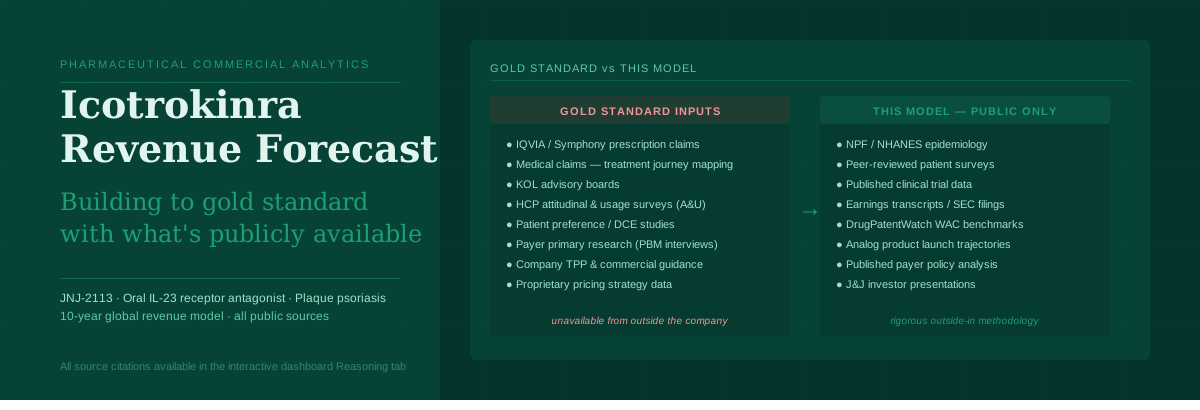
A gold-standard prelaunch revenue forecast for a specialty drug draws from a specific set of inputs that most people outside the launching company do not have: IQVIA or Symphony prescription claims for the existing market, proprietary medical claims to map treatment journeys and persistence, HCP attitudinal and usage studies to calibrate physician intent against revealed behavior, KOL advisory boards to test label assumptions and competitive positioning, patient preference surveys with discrete choice experiment design to quantify willingness-to-switch, payer primary research including direct interviews with national PBM formulary decision-makers, and the company’s own TPP, pricing strategy, and commercial channel guidance.
When you have all of that, the forecast is not easy to build — but the assumptions have a foundation that can be defended under scrutiny. The ranges compress. The scenario logic tightens. The connection between the model and the commercial strategy is direct rather than inferred.
I did not have any of it for icotrokinra.
What I built is the best outside-in forecast that public data and analytic discipline can produce. It is grounded in peer-reviewed epidemiology, published clinical trial data, documented earnings call guidance, SEC filings, payer policy analysis, patient preference survey research, and carefully selected analog products. Every assumption traces to a specific source. Where the data does not answer the question, the gap is named, the range is defined, and the analog reasoning that bridges it is explicit.

This article documents the methodology: what data I used for each assumption, what a data-rich model would add, and where the genuine uncertainty lives regardless of how much data you have.
Market Sizing: Where Public Data Is Actually Strongest
The addressable patient population is where the gap between public and proprietary data matters least, because the epidemiological foundation is well-documented and the publicly available claims-derived estimates are largely consistent with it.
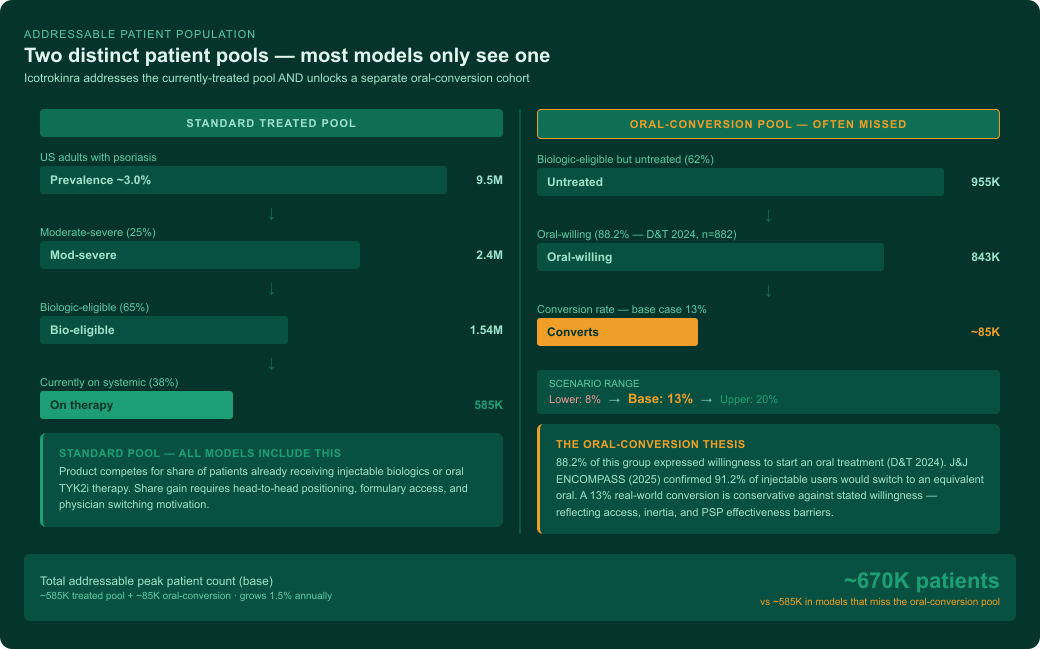
What I used: NPF prevalence data (approximately 3% of US adults with psoriasis) cross-referenced against NHANES-derived estimates. Moderate-to-severe share at 25%, sourced from the midpoint of the published clinical literature range of 20-30%. Biologic-eligible fraction at 65%, representing patients who have failed or are inadequate responders to topical or phototherapy. Treatment rate on systemic therapy at 38%, anchored to Protagonist’s SEC filing (January 2026) which cited 50-70% of biologic-eligible patients globally remaining untreated — implying the US treated rate sits meaningfully above the global floor.
What a data-rich model adds: Claims-based patient counts eliminate the funnel estimation uncertainty entirely. IQVIA or Symphony data gives you actual unique patients receiving any advanced therapy in the last 12 months, stratified by line of therapy, payer type, geography, and specialty. The gap between the claims count and the epi-derived estimate is itself analytically informative — it tells you whether the treatment gap is evenly distributed or concentrated in specific payer or geographic segments, which shapes the patient support and access strategy. Sub-national models (at census division or MSA level) are also possible with claims, enabling more precise sales force deployment planning.
What remains uncertain regardless: The growth rate of the treated patient pool. I applied 1.5% annual growth, consistent with GlobalData’s 10% CAGR for the 7MM PsO market. But treated patient volume is sensitive to payer access decisions and prescriber activation rates that are endogenous to the launch strategy itself.
The Oral-Conversion Pool: The Assumption That Differentiates This Forecast
This is the assumption that most external icotrokinra models either miss entirely or wave at without quantifying. It is also, in my judgment, the most commercially important assumption in the model.
The argument: icotrokinra is not simply competing for share of the currently-treated biologic-eligible patient pool. It is the first advanced therapy that is accessible to a subset of biologic-eligible patients who have specifically avoided injectable therapy. That population is real, it is documented, and it is activated by oral availability in a way that no injectable predecessor could achieve.
What I used: Two peer-reviewed or primary-source documents ground the estimate. A published patient preference survey (Dermatology & Therapy, 2024, n=882 US adults with moderate-to-severe psoriasis) found that 88.2% of untreated biologic-eligible patients expressed willingness to start a new once-daily oral treatment — the highest willingness rate of any patient subgroup. J&J’s own ENCOMPASS study (Fall Clinical Dermatology Conference, 2025, n=600 US adults) confirmed 91.2% of patients currently on injectables willing to switch to an equally effective oral, and 50.5% of all eligible patients preferring oral administration overall.
The model applies 13% penetration of the untreated biologic-eligible pool as the base case — approximately 85,000 patients at full ramp. This is conservative against the 88-91% stated willingness, but realistic against the combined barriers of formulary access, prescriber activation, and patient support program effectiveness that govern any new patient start in specialty dermatology.
What a data-rich model adds: A patient journey study with discrete choice experiment design would replace the stated-willingness figure with a quantified willingness-to-start under specific formulary conditions (copay, prior authorization requirement, out-of-pocket cost). This is the single highest-value primary research investment for this specific product — because the magnitude of the oral-conversion pool is the central commercial thesis of icotrokinra and it deserves better than a conservative discount on a stated preference survey.
A prescriber segmentation study would also identify which physician types are most likely to initiate the oral-conversion conversation — primary care dermatologists who refer out for biologics but might manage oral therapy themselves represent a categorically different promotional target than academic IL-23 specialists.
What remains uncertain regardless: How the untreated patient pool will actually present to physicians once an oral option exists. Some of these patients are truly injection-averse and will actively seek oral therapy. Others are simply undertreated due to access or awareness barriers that an oral product does not inherently solve. The actual conversion rate will be known within six months of launch from specialty pharmacy new patient start data.
Pricing: The Assumption Where External Models Are Most Consistently Wrong
Before I corrected the WAC assumption in this model, the prevailing external estimate for icotrokinra pricing was in the $40-45K annual range. This reflects a specific analytic error: using Sotyktu (deucravacitinib, $26K WAC) as the oral product pricing anchor rather than the mechanism-class pricing anchor.
The logic error is worth spelling out because it appears repeatedly in external forecasts for novel oral specialty drugs. Sotyktu is an oral TYK2 inhibitor with a PASI90 response rate of approximately 35% — materially inferior to injectable IL-23 inhibitors. It is priced at approximately one-third of the injectable IL-23 WAC because its efficacy warrants a discount to the class. Icotrokinra is an oral IL-23 receptor antagonist with a PASI90 response rate of approximately 50%, demonstrated superiority over Sotyktu in head-to-head trials, and a placebo-equivalent safety profile. It is not a better oral TYK2 inhibitor. It is an oral IL-23 inhibitor — a different mechanism with a different efficacy profile and a different pricing rationale.
What I used: The primary pricing anchor is Tremfya (guselkumab), J&J’s own injectable IL-23 inhibitor, with a published annual WAC of approximately $76,185 (DrugPatentWatch). A 10% oral convenience discount applied to this figure produces a base WAC of $68K. The 10% discount is supported by the Xeljanz precedent: tofacitinib launched in 2012 at approximately $24K — at parity with injectable TNF inhibitors priced at the same level — demonstrating that oral format alone does not require a mechanism-level discount when efficacy is equivalent.
Scenario range: $52K lower (aggressive access pricing, high payer resistance, competition with zasocitinib and envudeucitinib driving price pressure) to $75K upper (near-parity to Tremfya, accepted by payers on the basis of H2H IL-23 efficacy equivalence).
What a data-rich model adds: The company’s own pricing strategy work, ICER value assessment modeling, payer primary research on willingness-to-pay, and competitive pricing intelligence on zasocitinib and envudeucitinib launch pricing intentions. The last of these is particularly important: if Takeda prices zasocitinib (a TYK2i with strong Phase 3 data) at $30-35K, it increases payer pressure on icotrokinra. If they price at $45-50K, it validates a higher oral specialty pricing tier.
What remains uncertain regardless: The WAC is set at launch and difficult to revise upward. Getting this assumption right pre-launch is more consequential than almost any other single decision.
Market Share Ramp: Analog Selection Determines Everything
The most influential structural decision in any market share model is which product’s launch trajectory you use to parameterize the uptake curve. Use the wrong analog and you will systematically mis-shape the first five years of the forecast regardless of how accurate your peak share estimate is.
The wrong analogs: Tremfya (injectable IL-23, 3rd entrant to IL-23 class, injection-on-injection dynamics), Skyrizi (injectable IL-23, entered an already-crowded class), Sotyktu (oral TYK2i, constrained by JAK-class safety perception). All three are wrong because they do not match the competitive dynamic that icotrokinra faces: an oral product entering a market where every entrenched alternative requires injection.
The right analog: Xeljanz (tofacitinib) — first oral JAK inhibitor in rheumatoid arthritis, launched November 2012 into a market entirely dominated by injectable anti-TNFs. The parallel is structural: a genuinely differentiated oral option entering a class where patient needle aversion had been a documented barrier to therapy initiation. The Xeljanz trajectory: approximately $200M in Year 1, $500M in Year 2, $1.1B in Year 4. That is approximately 30% of eventual peak value by Year 4 — materially faster than any injectable-on-injectable analog.
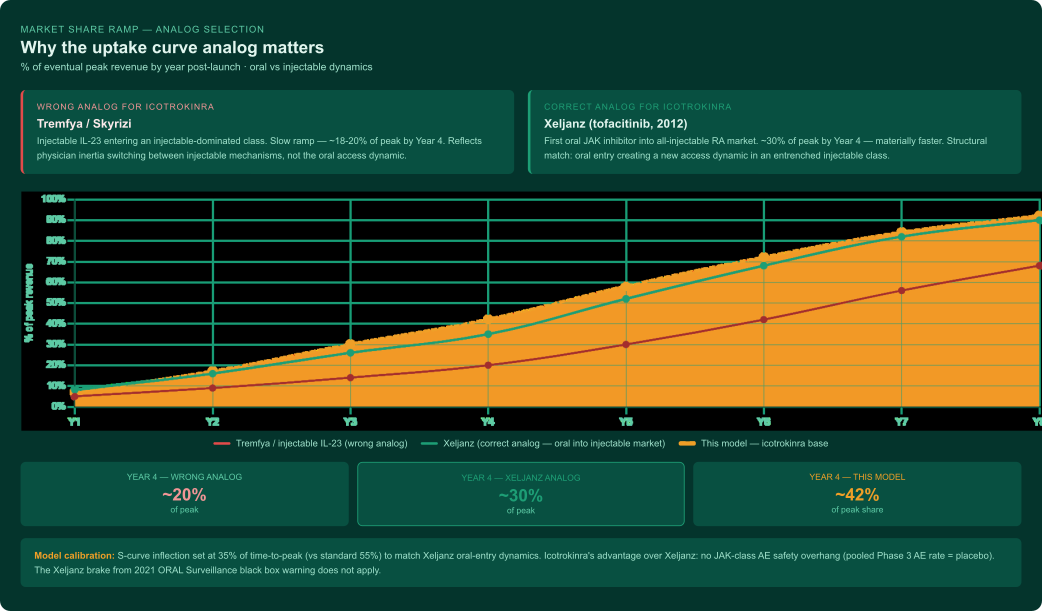
I parameterized the S-curve inflection point at 35% of time-to-peak (versus the standard 55%), which produces a Year 4 share of approximately 42% of peak. This matches the Xeljanz observed trajectory and is supported by the absence of the specific brake that slowed Xeljanz’s later ramp — the ORAL Surveillance post-marketing study that added a black box warning on cardiovascular risk in 2021. Icotrokinra’s pooled Phase 3 safety data shows adverse event rates statistically identical to placebo. That brake does not exist.
TPP factor adjustments: Entry order baseline (+12%, grounded in Xeljanz and injectable IL-23 analog data), oral convenience premium (+3%, ENCOMPASS data), H2H superiority vs. Sotyktu (+2%, ICONIC-ADVANCE 1&2), safety profile (+1%, pooled Phase 3 data), adolescent label (+1%, ICONIC-LEAD pediatric data), payer/access hurdle (-2%, launch-year step therapy inference from Sotyktu precedent), future TYK2i competitor entry (-3%, zasocitinib Phase 3 complete and NDA filing expected FY2026).
What a data-rich model adds: KOL advisory board inputs to validate the analog selection and test where icotrokinra will sit in the dermatologist’s prescribing algorithm. HCP A&U survey data to calibrate trial and adoption rates from intention-to-prescribe to revealed-behavior adjusted figures (typically a 50-75% discount). Prescriber funnel modeling: target physicians × reach rate × trial rate × adoption rate, cross-validated against the bottom-up patient flow estimate. Early adopter physician profiling to identify where the launch momentum will actually come from.
What remains uncertain regardless: Peak share. This is genuinely unpredictable at the 2-3 year pre-launch horizon for any novel mechanism. The model range of 10-22% reflects an internally consistent spread of commercial narratives, not false precision.
GTN and Payer Mix: Two Assumptions That Should Never Be Static
Both GTN and payer mix are functions of time in specialty drug markets. Treating them as fixed throughout a ten-year forecast is one of the most common technical errors in prelaunch modeling.
Payer mix drift: Psoriasis is a chronic disease. Patients initiated on commercial insurance in Year 1 age into Medicare at a predictable rate — approximately 0.8 percentage points per year based on the chronic disease aging dynamics documented in Medicare claims literature. A model that holds commercial mix at 55% through Year 10 is overstating commercial revenue in the outer years and understating Medicare rebate exposure.
GTN evolution: Year 1 commercial GTN of 42% reflects unfavorable launch access: step-therapy requirements, tier-3 nonpreferred specialty placement, high prior authorization burden. This is the documented Sotyktu Year 1 experience. It improves as real-world evidence accumulates and J&J negotiates preferred formulary placement — approximately 4 percentage points by Year 5 in the base case. The Medicare channel receives an additional 6 percentage point headwind from Year 8, reflecting IRA MFP negotiation eligibility for small molecules approximately 9 years post-approval.
What a data-rich model adds: Payer primary research — direct conversations with national PBM and health plan formulary decision-makers — tells you the Year 1 access trajectory from actual intent rather than analog inference. This is the single highest-impact primary research investment for access modeling. The difference between a product that achieves preferred specialty tier at CVS Caremark in Year 1 versus Year 3 is not a small GTN delta — it is a ramp shape difference that compounds across the entire forecast horizon.
Payer primary research also surfaces requirements that have no analog precedent: if a payer intends to require step-through both Sotyktu and apremilast before icotrokinra, that is a Year 1 access profile with no direct comparable in the history of the IL-23 class.
What remains uncertain regardless: The IRA negotiation outcome. For small molecule drugs negotiated approximately 9 years post-approval, the IPAY discount (the reduction from WAC applied under MFP) ranges from 25-60% in the early rounds of negotiation. The model applies a 6 percentage point Medicare GTN headwind to proxy this, which is conservative. The actual outcome will depend on comparative effectiveness evidence and negotiation dynamics that cannot be modeled from public data.
How the Outputs Compare to External Benchmarks
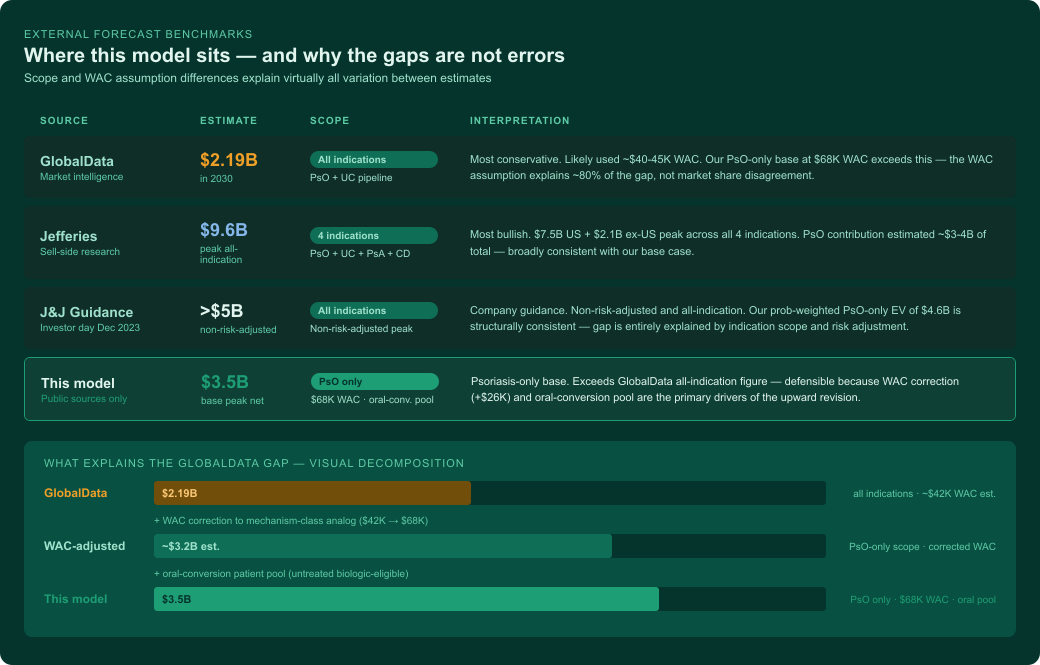
| Source | Estimate | Scope | Implied WAC |
| GlobalData | $2.19B (2030) | All indications | ~$40-45K (estimated) |
| Jefferies | $9.6B peak | All indications (PsO + UC + PsA + CD) | Not specified |
| J&J Guidance | >$5B | All indications, non-risk-adjusted | Not specified |
| This model (base) | ~$3.5B peak | Psoriasis only | $68K |
The GlobalData figure being below our psoriasis-only estimate is explained almost entirely by the WAC assumption difference, not a market share or epidemiology difference. If GlobalData used a $42K WAC, their $2.19B all-indication figure would scale to approximately $3.5-4B at $68K WAC — broadly consistent with our psoriasis-only estimate before adding UC and PsA pipeline contributions.
What This Demonstrates About Outside-In Forecasting
I built this model without a single proprietary data point. Every assumption is sourced to a publicly available document. The result is not as tight as what the full commercial data stack would produce — the scenario ranges are wider, several assumptions carry more uncertainty than they would with primary research grounding, and the prescriber behavior layer is inferred rather than measured.
But the architecture is identical to what a data-rich model requires: traceable sourcing for every assumption, dynamic modeling for parameters that evolve over time, scenario logic expressed as commercial narratives rather than arithmetic ranges, and explicit naming of the assumptions that remain genuinely uncertain.
If I had the full stack, this is what I would do differently: replace the epi-derived patient count with claims-based figures, replace the stated-preference oral conversion estimate with a discrete choice experiment result, replace the analog-derived WAC with company pricing guidance and payer WTP research, replace the Xeljanz S-curve calibration with a KOL-informed trial-and-adoption prescriber funnel, and replace the access trajectory inference with payer interview data.
The forecast would be tighter. The commercial strategy it supports would be more directly actionable. But the questions would be the same — and the standard of what constitutes a credible answer would be the same.
See the Dashboard
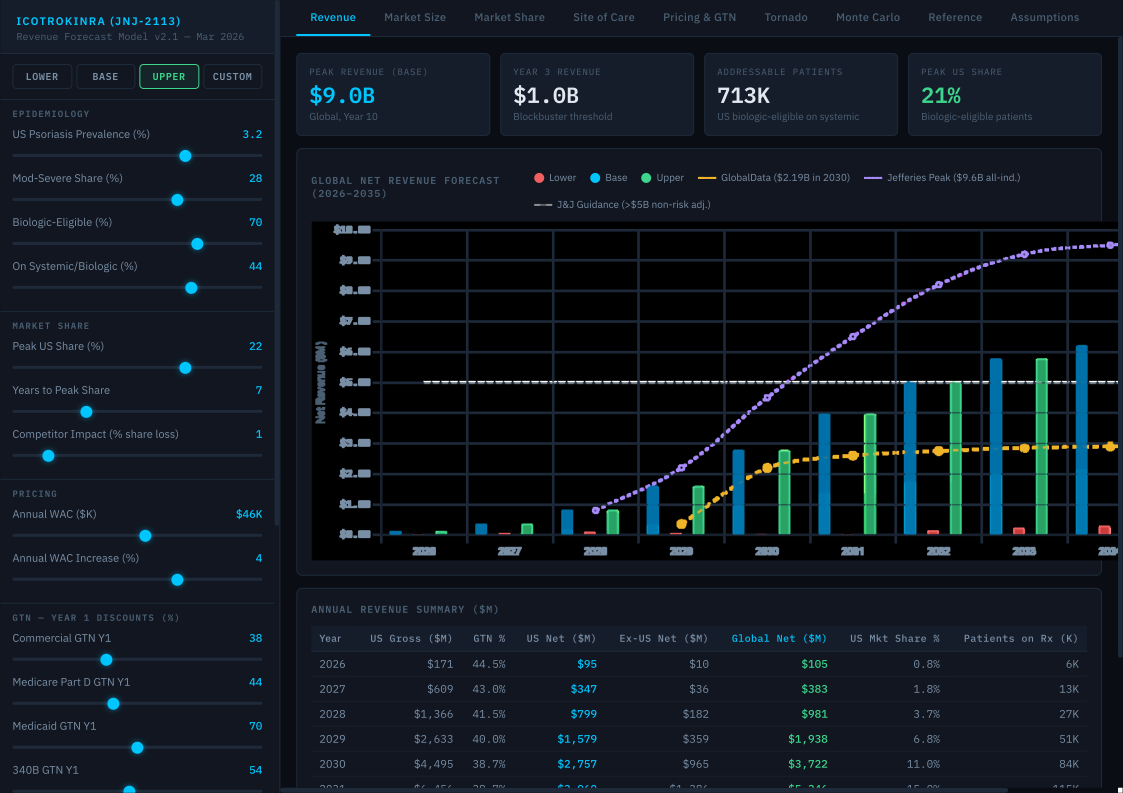
Above is how it looks. The full interactive model — with all assumptions, source citations, dynamic GTN and payer mix, scenario narratives, and Monte Carlo simulation — is available here: [Dashboard link]
The Reasoning tab is worth the time. The goal was to make the analytical thought process transparent enough that a peer could see exactly where the outside-in methodology bumps against what only proprietary data can resolve — and where it turns out public sources, used with discipline, close the gap further than most outside forecasts demonstrate.
About the Author: Woranat Wongdhamma, PhD. Life sciences commercial analytics practitioner with 10+ years building forecasting models, resource optimization and measurement frameworks, omnichannel engines, and field intelligence systems. Creator of NicheLabz.
Email: woranat.wongdhamma@gmail.com | LinkedIn: https://www.linkedin.com/in/wworanat
Disclaimer
This article and the associated interactive model are the independent work of the author and are based solely on publicly available information. Sources include published clinical trial results, U.S. SEC filings, publicly reported earnings call transcripts, peer-reviewed epidemiological and patient preference literature, publicly reported wholesale acquisition cost benchmarks, and publicly disclosed investor guidance. No proprietary, confidential, or non-public information has been used.
This content is not affiliated with, sponsored by, endorsed by, or produced in connection with Johnson & Johnson, Janssen Pharmaceuticals, Protagonist Therapeutics, or any of their affiliates, subsidiaries, or representatives. The product name icotrokinra (JNJ-2113) is referenced solely for the purpose of professional analytical commentary on a publicly discussed pharmaceutical development program.
All revenue forecasts, market share estimates, pricing assumptions, and scenario analyses are the author’s independent judgments, prepared for professional discussion and illustrative purposes only. They do not constitute investment advice, a securities recommendation, financial advice, or a solicitation to buy, sell, or hold any security or financial instrument. Readers should conduct their own due diligence and consult qualified financial and legal advisors before making any investment decision.
Forward-looking statements and projections involve inherent uncertainty. Actual clinical, regulatory, commercial, and financial outcomes may differ materially from any estimates presented. The author makes no representation as to the accuracy, completeness, or fitness for any particular purpose of any information contained herein.
The author holds no financial position — long or short — in any security referenced in this article.